
Are you tired of fire suppression designs that overcomplicate your project, stall your permit approvals, and blow your budget before the first pipe is even laid?
In the fast-paced world of British Columbia real estate development, "simple" is often the hardest thing to achieve. Between the evolving BC Building Code (BCBC) and the unique bylaws of municipalities like Surrey, Burnaby, and Vancouver, getting your sprinkler system design right the first time is the difference between a profitable hand-over and a costly delay.
At Voltas Engineering Ltd, we have spent over 30 years in the construction industry. We’ve seen every mistake in the book, and we’ve spent three decades fixing them. As your "guardians" in the engineering space, we believe that the best fire suppression design isn't the most complex one: it’s the one that is code-compliant, cost-effective, and easy to install.
Here are 10 critical things every BC developer needs to know about sprinkler system design today.
1. Understanding the "Alphabet Soup" of NFPA Standards
When you sit down with a mechanical engineer, you’ll likely hear them throw around numbers like 13, 13R, and 13D. These refer to the National Fire Protection Association (NFPA) standards adopted by the BC Building Code.
- NFPA 13: This is the "gold standard" for commercial buildings and high-rise residential. It provides the highest level of protection but is also the most expensive to design and install.
- NFPA 13R: Specifically for residential buildings up to four storeys. It focuses on life safety (getting people out) rather than property protection (saving the building structure), making it more economical for multi-family developers.
- NFPA 13D: Designed for one- and two-family dwellings and manufactured homes.
Why does this matter to you? Choosing the wrong standard can lead to massive over-engineering or, worse, a rejected permit.
2. The Impact of the 2024 BC Building Code Updates
The BC Building Code is not a static document. The recent 2024 updates have introduced shifts in how we approach secondary suites and townhomes. For instance, many townhouse projects that previously required professional design are seeing changes in how fire flow is calculated.
Staying ahead of these changes is part of our role at Voltas Engineering. We ensure that your sprinkler system design complies with the latest provincial mandates, preventing the need for mid-construction retrofits that can haunt a developer’s bottom line.
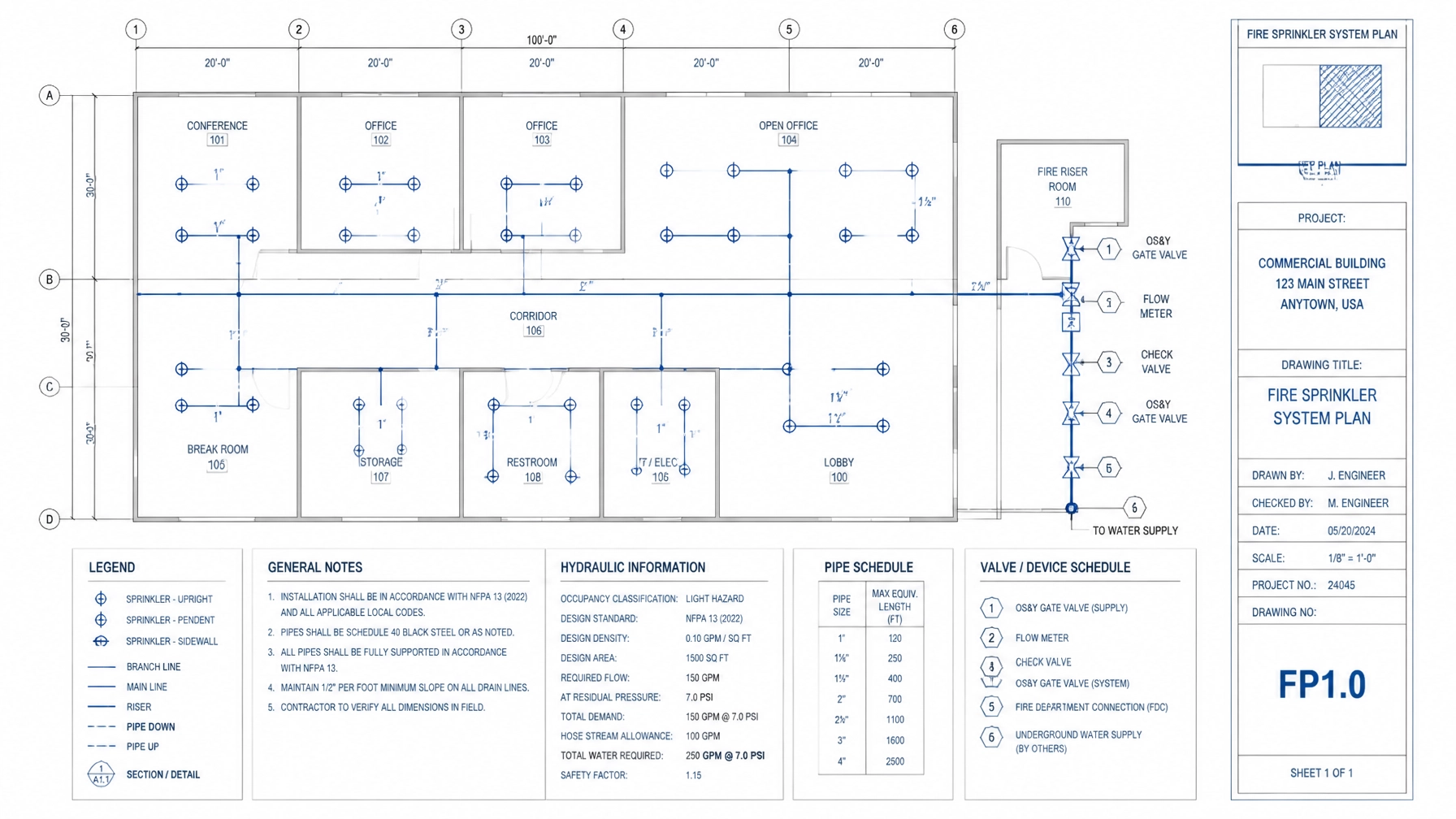
3. When is a "Professional Seal" Mandatory?
In British Columbia, not every sprinkler design requires an engineer’s stamp: but most do. While the BC Building Code allows for certain NFPA 13D and 13R systems to be designed by qualified contractors in specific scenarios, municipalities like Vancouver often require a Professional Engineer (P.Eng) for almost all fire suppression systems.
Having a professional design from the start provides a layer of liability protection and ensures that the system integrates seamlessly with your overall MEP (Mechanical, Electrical, and Plumbing) engineering.
4. Fire Flow: The Silent Project Killer
Before a single sprinkler head is installed, we have to look at what’s happening underground. Fire Flow is the amount of water available from the municipal grid to fight a fire. If the city’s water pressure is too low, you might be forced to install a fire pump or a massive on-site storage tank: costs that can reach six figures.
At Voltas Engineering, we perform rigorous hydraulic calculations early in the design phase. We use Fire Underwriters Survey (FUS) methods to determine the Needed Fire Flow (NFF). By identifying water supply issues early, we help you pivot your design before the budget is set in stone.
5. Integrating Sprinklers with MEP Coordination
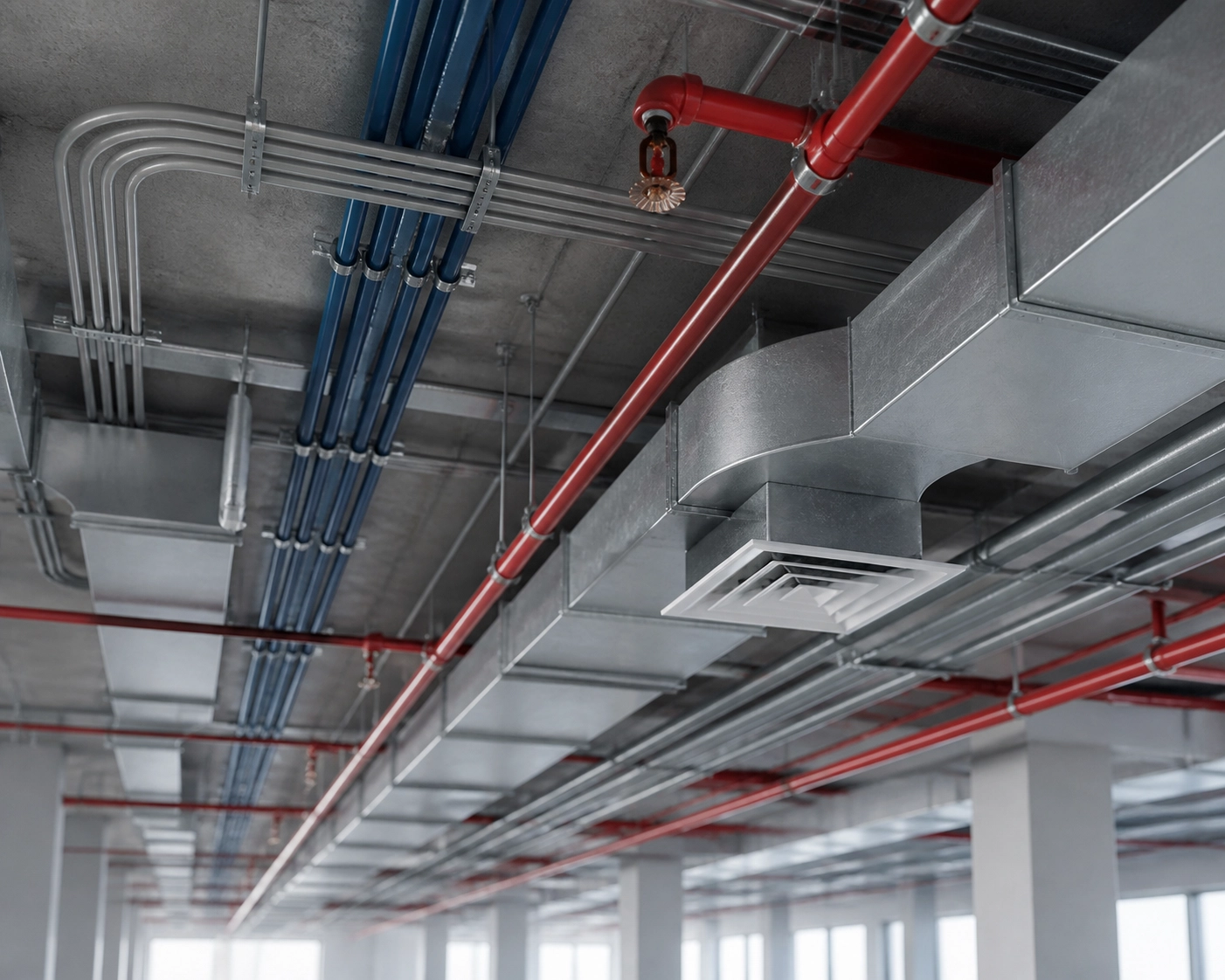
A sprinkler system doesn't exist in a vacuum. It has to share ceiling space with HVAC (Heating, Ventilation, and Air Conditioning) ducts, electrical conduits, and plumbing lines. This is where many projects fail.
When you work with a full-service firm, we coordinate your mechanical design with your fire suppression. Using modern tools like BIM (Building Information Modelling), we can visualize "clashes" before they happen on-site. This prevents the dreaded scenario where a sprinkler head is blocked by a giant ventilation duct, requiring a complete redesign of the ceiling.
6. Residential vs. Commercial Nuances
Are you building a warehouse in Surrey or a condo complex in Burnaby? The requirements for fire suppression design vary wildly between the two.
- Commercial: Often requires "Extra Hazard" or "Ordinary Hazard" classifications, meaning larger pipes and more water.
- Residential: Focuses on aesthetics. No homeowner wants a bulky, industrial-looking sprinkler head in their living room. We specialize in concealed, low-profile designs that provide safety without sacrificing the interior design.
7. The Importance of Municipal Bylaws
While the BC Building Code provides the baseline, local municipalities have the final say. For example:
- Surrey: Known for strict adherence to fire access and specific hydrant distances.
- Vancouver: Often has higher sustainability and fire safety standards than the provincial minimum.
- Burnaby: Frequently requires specific noise mitigation for mechanical components (like fire pumps).
Our team is intimately familiar with the local permit offices across the Lower Mainland. We know what they are looking for, which speeds up your approval process.
8. Simple Solutions for Complex Problems
There is a trend in engineering toward over-complication. Some firms will design the most technologically advanced system possible because it looks good on paper. But can your trades actually build it?
With 30 years of construction experience, Voltas Engineering prioritizes "constructability." We design systems that use standard components and logical routing. This makes the installation faster for your sub-trades and reduces the likelihood of errors during the inspection phase. We believe in optimizing building design for both performance and simplicity.

9. Secondary Suites and High-Density Housing
BC is pushing for higher density, which means more secondary suites and laneway houses. The fire suppression requirements for these can be tricky. Does the suite need its own shut-off valve? Does the whole building need to be upgraded if you add a suite to an existing home?
We help developers navigate these "gray areas" of the code to find the most cost-effective path to compliance. Often, a clever sprinkler system design can save you from having to do a full-scale building upgrade.
10. Planning for Future Maintenance
A fire suppression system is an active part of the building for its entire lifespan. As a developer, you want to hand over a building that isn't a maintenance nightmare for the future strata or owner.
We design with the end-user in mind, ensuring that valves are accessible, drainage points are logically placed, and testing ports are easy to reach. This "guardian" approach ensures your reputation as a quality developer remains intact long after the project is sold.
Why Voltas Engineering?
Choosing the right partner for your sprinkler system design is about more than just getting a set of drawings. It’s about hiring a team that understands the "why" behind the code and the "how" of the construction site.
Whether you are working on a small residential infill or a massive commercial warehouse, our commitment is the same: simple, code-compliant, and dependable engineering.
- 30+ Years of Experience: We’ve seen the industry evolve and we know how to navigate it.
- Full MEP Integration: We handle the mechanical, electrical, and plumbing to ensure everything works together.
- Local Expertise: From Surrey to Vancouver, we know the local landscape.
Ready to Streamline Your Next Project?
Don't let fire suppression be the bottleneck in your development schedule. Let us take the complexity out of your engineering so you can focus on building.
Contact us today to discuss your project or get a quote.
- Explore our Services
- Learn more About Voltas
- Check out our latest Projects
By prioritizing smart, simple design today, you are protecting your investment, your future tenants, and our BC communities for years to come.